Sunday, 28 April 2013

From Garden to Grammar - an African Success Story

FROM GARDEN TO GRAMMAR
An African Success Story

There are many tales of talented individuals rising from impoverished roots to become players in sophisticated modern society. But in Africa it’s a celebration. And this is one of them.

Born in the poor, remote African village, Tchoko, in Malawi’s northern region in 1982, Everson Luhanga was named Komani after his uncle.

The family of nine lived off the land and the only means of earning an income was to sell what food they had left after feeding the family.


Everson's mother pounding nuts
Understanding the value of education, as all African parents do, Komani’s parents sent him to the local Kaonekara Primary School.  Despite most of the village children not being able to attend school for various reasons, it was his father’s determined wish that Komani got a good education. And he had a plan in mind.
Everson's father
When he was ready to enter junior school, his father sent him to stay with his married sister in town. On arriving in town he changed his name to Everson because Komani wasn’t easily pronounced in the area’s dialect.


Everson ploughing the fields
Everson was a clever pupil and excelled in all subjects except maths. But he particularly liked reading and writing. Spending hours listening to the radio and reading newspapers eventually convinced him that he wanted to become a journalist. It was the only job that would satisfy him.

After matriculating, Everson enrolled at the Malawi Institute of Journalism (MIJ) to study a journalism diploma. But he was kicked out just three weeks into the first year because of an outstanding fees balance which his parents couldn’t afford to pay.

‘My father, who used to sell his livestock to pay for my secondary schooling, could no longer afford to pay for my tertiary education. The fees were too expensive to be paid by selling a cow.’

Everson was left with no options, and in 2004, six months after being dismissed from the college, he made arguably the biggest decision of his life – to emigrate to South Africa in pursuit of his dream.

The only work Everson could find in the new country was gardening. But Alison Ramsden, his employer in Parkmore, Sandton, was to become a turning point in his career.

‘As a Christian, I know now that God introduced me to a family who treated me like a son.’


Alison and Everson chat about his future
Although fully occupied with his gardening work, Everson communicated with Alison when he drew up shopping lists and sent birthday and Christmas greeting cards. And during his meal break he could be found either writing or reading a book. 

Over the years, Alison noted with mounting interest the exquisite greeting cards and his preoccupation with writing and reading. She supported this dedication by buying him books, pens and numerous notebooks. Eventually she also learnt, to her surprise and delight, of his passion to become a journalist.

To achieve his journalistic aspirations, Alison knew Everson needed further education. She made enquiries and found several short courses at the South African Writers’ College which would suit him. He was elated when she offered to sponsor him and took up the challenge with zest and characteristic determination.

Everson completed the courses and pocketed two distinctions and a merit award. But there was a surprise. Owing to his outstanding performance, the college granted him a bursary to study its Hard News Journalism course.

Everson’s tutor at SAWC was journalist and former editor, Beth Howell, who, according to him, had a marked influence on his career:

‘It turned out that Beth was more than just my tutor. I noticed during the course that she went beyond her brief to mentor and encourage me. She was more like a parent who wanted her child to succeed.


Journalist and teacher Beth Howell
‘Before I completed the course with Beth, I was writing commentary and letters to various publications, including The Star, The Times, YOU Magazine, and the Daily Sun. Seeing my name in print raised my energy levels and I began looking for markets to sell my stories.

‘A local community newspaper published my first article and soon after that I became one of 20 people invited by the Daily Sun on a one-year training course. I was nervous because many of those attending came from recognised media schools. But here again, Beth was behind me. I asked her advice and she unhesitatingly told me to accept the challenge.

‘It was a great challenge but I managed to rise to the occasion. Of the 20 attendees only five survived and I was one of them. I was awarded a certificate of accomplishment in the Media Law Course at the end of 2011.’

Everson in the Daily Sun newsroom
While Beth’s invaluable mentoring and inspiration saw him safely on the path of journalism towards a successful future, he fondly remembers the key and compassionate role played by the other woman who made a positive difference in his life:

‘Besides paying my college fees, Alison was also a great mentor. She helped me to develop a business mind and emphasised that the power of any business lies in networking. She was my first beacon of hope and the turning point of my life in South Africa.’


Alison and Everson - graduation day!
Everson has gone from strength to strength and is now a proud journalist at the Daily Sun. And he’s living the dream:

‘This is my whole life. I don’t want to do anything but read and write.’

Everson still lives with the Ramsdens in Sandton and has become a member of the family. But he’s not getting much gardening done.


In the garden

A man of letters

Victoria and Alison 


Saturday, 27 April 2013

VIVA FREEDOM! GREAT STRIDES, GREAT STRIDES

South African President Jacob Zuma says great strides have been made since 1994. And for once he's right. Often I disparage him for speaking untruths, half-truths or just plain rhetoric. But finally, I agree with him.

Property development since 1994 has soared, particularly in the R200 million-plus bracket. One shining example is a homestead in Nkandla that was once a compound but has been refurbished as a palace at the relatively low cost of around R250 million. Resourceful project management has seen the iconic dwelling mushroom in the rural foothills of KwaZulu-Natal and it has set the benchmark for this multimillion rand industry in South Africa. What drove this magnificent piece of architecture is uncertain but economists suggest the largesse of the South African economy might be the reason. Whatever the reason, it's here to stay, and sets a shining example to young entrepreneurs about what might be achieved with a little common sense, craft and financial diligence. It has caused such a stir, that rumours suggest it may even be proclaimed a national monument and possibly the biggest fortress ever built in South Africa. Nostalgically it evokes the glory and grandeur of those good old feudal days and is a fitting tribute to the history of this great country and it's willingness to always help those in need.

The other great stride since 1994 is, of course, corruption. Few would argue that this vigorous and highly competitive industry has come along in leaps and bounds over the last two decades. It is now a multibillion rand industry and one of the fastest growing in South Africa's economic sector. Because of its growing and enormous potential there are moves afoot to include it in the Gross Domestic Product, primarily to clean up its image and boost the South African economy. 

So our beloved country has much to look forward to in the next ten years. An upturn in the economy built on flourishing corruption and a nationwide property boom of palatial magnitude.

Viva freedom!

Friday, 26 April 2013

MEDIA GROUP RAISES CONCERNS OVER SECRECY BILL IN ITS CURRENT FORM

The Southern African Freelancers' Association (SAFREA) today issued a press release raising concerns over the Protection of Information Bill in its present form.

The Bill was passed by majority vote in South Africa's Parliament yesterday and will now be forwarded to President Jacob Zuma to be signed into law.

Safrea drew on a quotation from American writer and activist Noam Chomsky which aptly describes the relationship between free speech and a democracy:

"If we don't believe in freedom of expression for those we despise, we don't believe in it at all."

The full text of the press release appears below.

The Southern African Freelancers' Association stands opposed to the passing of the Secrecy Bill in its current form.

"Although the Secrecy Bill that was passed yesterday is a considerably improved version compared to what was presented last year, it remains a threat to freedom of speech, exposing journalists and whistle-blowers to real and significant risks, including a jail sentence of up to 25 years when reporting on certain matters in the public interest.

"The limited protection the bill offers journalists and whistle-blowers will no doubt result in an unacceptable environment of secrecy, fear and intimidation. This does not bode well for responsible journalism in South Africa, for the livelihood of those pursuing honest careers in what should be free media, or for the South African public," says Safrea chair, Helen Ueckermann.

The Secrecy Bill must be weighed and tested against the South African constitution. Legislation of this nature undermines and erodes the sacrifices endured during the Struggle, and all that it stood for. Passing the bill makes a mockery of the constitutional safeguards on free speech.

"The media's role as watchdog, and its responsibility towards the public to report on classified information exposing corruption or criminal activity, will be severely hampered with the passing of the bill," says Ueckermann.

There can be no true democracy where there is a limitation on freedom of speech. In the words of American linguist, philosopher, historian, political critic, and activist, Noam Chomsky, "If we don't believe in freedom of expression for those we despise, we don't believe in it at all."

Thursday, 25 April 2013

LATEST REPORT FROM ST FRANCIS BAY RESIDENTS' ASSOCIATION

Below is the latest report from the St Francis Bay Residents' Association.

25 April 2013

Hi  Folks                                                                                                                 
Since the end of January this year a number of interesting things have happened in St Francis Bay.
• Firstly, the Tourism office has been relocated to Viking Bakery and approval has been given by Council to put up new signage directing people to this new office.
• The second significant happening has been the formation of a Business Chamber, which has been set up to address business issues within the Greater St Francis Bay area.  They have already achieved considerable success in discussions with council and other parties and a new committee is being put in place.  The Residents' Association is very supportive of the endeavours of Tourism and the Business Chamber.
• We are, once again, trying to get the residents of Sea Vista to form their own Residents' Association so that we have greater representation when dealing with council. 
• The street sign community project run by the SFB Residents Association is in the final throes of being put together.  This project will manufacture street signs conforming to Council requirements.  These curb-type signs will be manufactured locally creating employment.  We are hoping that businesses will come forward and sponsor these signs.
• It appears that the Parks grass cutting team has stopped their ‘go slow’ and is now back at work, long may this continue. 
• Two of the bad areas on St Francis Drive on the way to the Port have now been permanently repaired and the remaining section adjacent to Tarragona as well as the bend in Tarragona will be repaired shortly by Council.  The replacement of the mains water pipe in Lyme Road North is progressing well and most of the piping has been laid.
• The St Francis Bay Golf Club is in the process of finishing a contoured drainage system taking storm water away from flooding the areas adjacent to St Francis Drive down to the sea.  Council employed an outside contractor to put in a new storm water pipe system under the main road which will significantly help avoiding the damming of water.  This project was required to be completed prior to the winter rains. 
• Recently the new donated fire boat equipped by the Riparian Association was demonstrated to the media and public in the small boat harbour.  The water pressure allowed for five hoses to be attached simultaneously with significant water pressure.  As an aside, many of the houses destroyed in the fire are being rebuilt which is gratifying to see as it has created job employment and proves that SFB is still many peoples favourite holiday destination. 
• The wind farm on the Oyster Bay road has started.  The contractors Red Cap have agreed to have regular meetings with the community to update us on progress.  This project is significant for St Francis Bay as it will be employing 50% of its labour from Sea Vista. 
• We asked Council for an explanation as to why there is such a discrepancy in the meter reading period going from anything from 28 days to 41 days.  Herewith an explanation from Council:-  
“Electricity payments.  The municipality would like to apologise for those instances where the period between meter readings was exceptionally long.
Unfortunately, there are a number of factors that influence the length of periods and over which the municipality does not have control, for example, the weather.
We can assure residents, however, that the municipality is looking at adapting the programme used to calculate electricity usage to ensure that residents are charged correctly regardless of the length of the period between readings.
Residents who believe they have been overcharged for electricity can send their particulars to the municipality - in writing please - so that we can follow up on it.  
• We have had sight of the Kouga Municipality Draft Budget 2013/2014.  There are many issues in this budget which we are not happy with and are in the process of addressing.  This includes a proposed rates increase of 13% and staff salary increases of 11.8%. 
• A number of concerned property owners have approached the Residents Association with a view to assisting us in increasing our membership especially those people living in the Gauteng and Kwazulu Natal areas.  This endeavour is greatly appreciated by the Residents Association, as without more people paying membership fees it is impossible for us to continue with our projects as well as effectively represent property owners in St Francis Bay.

Jacky Green
Administration manager  

Friday, 19 April 2013

SA MILITARY UNION ALLEGES SANDF WITCH-HUNT FOR CAR WHISTLEBLOWERS

A press release just received suggests that South African Defence Force chief, General Solly Shoke, has a ordered a military intelligence operation to uncover  the identities of persons who leaked information to the media on anything involving the Central African Republic. This is the statement:

SOUTH AFRICAN NATIONAL DEFENCE UNION IN REACTION TO RECENT INFORMATION THAT CHIEF SANDF HAS ORDERED AN INTELLIGENCE OPERATION TO IDENTIFY ALL PERSONS WHO LEAKED INFORMATION TO THE MEDIA REGARDING THE CAR.

19 APRIL 2013


SANDU has been alerted to the fact that Chief SANDF General Solly Shoke has ordered a military intelligence operation to identify all persons who have 'leaked' information to the media on anything to do the Central African Republic deployment. 

SANDU views this in a very serious light as no crime has been committed and no troops were endangered by information obtained by the media. The only danger being in the fact that our troops shouldn't have been placed in the predicament it had been in the first place. The only 'damage' caused was a massive embarrassment to Government s not by people telling the full truth.  

This Intelligence  operation is a blatant abuse and waste of state resources and should not be tolerated. We implore SANDF management to rather better its communication skills with the public of South Africa, than engage in a petty Apartheid styled witch hunt against the media and its sources. This is impeding on freedom of the press and information, as the public's right to know the truth behind the unnecessary and untimely death of our troops in the CAR.

This latest development compounds the suspicions of a  cover up.

JG Greeff 
NATIONAL SECRETARY SANDU

Friday, 15 March 2013

A MAMPARA FOR ALL SEASONS

Mamparas come in all shapes and sizes but the one heading the Eastern Cape education department will always be a leading candidate for the much sought after accolade which, in South Africa, is distributed with remorseless regularity, for they are legion. If I didn't know better, I'd swear  the SA government had a breeding programme to churn them out.

The prizewinner is MEC for EC Education, the esteemed (or so he thinks) and pontificating Mandla Makapula, who was quoted as telling a group of South African pupils recently that they had no rights. Read it again, it isn't a misprint. Here is what he said:

'For you, rights come later in life when you are independent, finished studying and have your own place to stay and your own car. That is when you can start talking about rights.'

According to the Mail & Guardian he was allegedly referring to an Eastern Cape boy who took his father to court after he was forced to attend initiation school. This is what he added: 

'I asked myself what was wrong with that boy. His father did go to the initiation school but, because of the rights now, he did not want to go there himself ... I wish he could have been my child, I would have hit him on the head with a knobkerrie and he would have gone to that initiation school crying.'

The province's education department moved swiftly to downplay Makapula's patriarchal dogmatism with an even more absurd statement from spokesman Loyiso Pulumani, who told the M&G:

'He said these things in jest, he was only trying to be humorous. He wasn't suggesting in any way that children don't have rights.'

He perhaps forgot to add that it was a perverted sense of humour, if that was the case. But I suspect, as I imagine will many readers, that it is a ridiculous excuse for authoritarianism, patriarchal dogmatism and pomposity. It's pretty much how the government runs this country and then moves quickly to dispel scandal and controversy with ludicrous and laughable spin that is so obviously rubbish.

The wildly spinning Pulumani said the provincial minister did not say these things 'in so many words'.

'There has been a misunderstanding of African idioms here. You need to try to understand the cultural differences here and the nuances in language.'

Pulumani may need to get a firm grasp of linguistics or he'll spin himself into a tizz. Unless he's aiming for the mampara of spin accolade.

Regional director of the Legal Resources Centre (LRC) told the M&G that Makapula's comments are an example of the 'state of chaos in the Eastern Cape department of education'.

So the country ploughs on under the leadership of pontificating incompetents hell bent on self-aggrandisement rather than the interests of the populace.

We have become a nation beset by a rampant and self-enriching mamparadom.


Tuesday, 5 March 2013

TAKE A WALK ON THE WILD SIDE

A unique and unspoilt wilderness along South Africa’s east coast  offers unsurpassed and memorable experiences of culture, history and natural beauty to tourists searching off the beaten track.

The Eastern Cape province of South Africa holds many rich and varied interests for travellers, but one of the most compelling – dubbed an untamed wilderness – is the magnificent Wild Coast along its eastern coastline. 

Stretching from the Mtamvuna River in the north to the Great Kei River in the south, the roughly 300-kilometre coastline offers unlimited leisure options, a rich cultural heritage, spectacular views of jagged cliffs, coastal waterfalls, sheltered bays, vast empty beaches, shipwrecks, indigenous African villages and lush rolling hills and valleys. Despite all it has to offer it is not extensively developed (hence its name), and one can rub shoulders with local farmers and chat to Xhosa tribesmen as a matter of course on any given day.

Wild Coast
Typical Wild Coast landscape
           
Ancient forests abound with cycads, yellowwood trees and bird and animal life. Approximately 320 bird species make the area their home and the rich coastline has abundant marine life packed with around 800 fish species. Deep sea, rock, surf, fly and spear fishing are much sought after activities.

The idyllic setting is home to former South African statesman, Nelson Mandela, whose home at Qunu is the area where he was born and grew up as a boy. Much can be learned about his early life in nearby Mthatha at the Nelson Mandela Museum. 

Qunu 

One tour operator aptly described the Wild Coast thus:

‘It only takes a few days before the magic of the Wild Coast starts to work on your soul and very soon you catch Pondo fever (laziness fever). The rest is history.’

Mbotyi

A good place to start exploring the Wild Coast is the quaint, picturesque and historically interesting Mbotyi. The literal translation of Mbotyi is ‘place of beans’ owing to the rich, fertile soil being ideally suited to the growing of any kind of bean.

The hamlet was created in 1922 by deed of grant and is one of the few sites along the wild coast which confers freehold title upon its owners. It has changed ownership several times and was bought in 1985 by Dr Liso Mazwai, with a view to building a hotel. 

Mazwai completed the hotel in the late 1980s but was forced to close the doors in 1993 following the assassination of Chris Hani and the ensuing political turmoil in the region. At the time the hotel was quickly evacuated and some guests had to abandon their cars and were flown out by helicopter. Amazingly it was never vandalized and, for almost a decade, table place settings, which remained intact, and overgrown lawns were a haunting reminder of its prestigious past.

In 2001, new owners bought the site and restored the Mbotyi River Lodge to its pristine best. The area relies entirely on the lodge as an employment generator for people living in and around the hamlet.

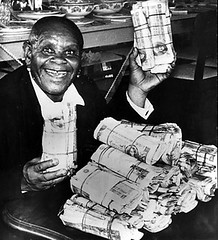
The place is renowned for having spawned and moulded one of South Africa’s great herbalists, Khotso Sethuntsa, reputed to be the grandchild of President Kruger’s coachman and privy to where the Kruger millions were buried. Appropriately he always celebrated Kruger Day with great enthusiasm and would invite celebrities from all over South Africa to attend. Khotso made a fortune selling his potent muti (African medicine or magical charms) and built splendid palaces outside Kokstad, Mt Frere and Lusikisiki for himself and his followers. Fascinating supernatural anecdotes (some involving Khotso) abound and can be heard at the lodge or read on their website www.mbotyi.co.za. 

Khotso with Banknotes
Khotso with banknotes - Courtesy BooksLIVE

Mbotyi is a seaside hamlet in the Pondoland region of the Wild Coast north of Port St Johns. Among the many activities to be found in this beautiful, rugged area are birding, canoeing, fishing, hiking and horse trails, mountain biking, open landrover routes, swimming, waterfalls and the astonishing Sardine Run in June/July that can be seen from numerous vantage points when whales, dolphins, sharks, gannets and seals feed on the massive shoals of sardines along the coast.

Seascape at Mbotyi

Hole in the Wall

The main attraction and outstanding peculiarity of the Wild Coast is the Hole in the Wall, near the busy surfing town of Coffee Bay. Known to the locals as esiKhaleni (the place of the sound), this offshore, stand-alone natural rock, with its iconic wave-worn centre hole created by centuries of pounding waves, is a geological phenomenon that explodes in sound through the valley when waves crash against it at high tide.

Xhosa mythology believes it was created by the ‘sea people’, a race resembling humans with supple wrists and ankles and flipper-like hands and feet.

Hole in the Wall 

Wild Coast shipwrecks

The fascinating and romantic history of Wild Coast shipwrecks is a story on its own and the treacherous seas in some parts of the region have claimed the lives of many victims. Some ships were thrown onto the shore while others perished beneath the waves and divers today still comb the area in search of lost treasure.

• Oceanos (1991) sunk in heavy seas near the Hole in the Wall.
• Jacaranda (1971) ran aground following engine failure in heavy seas.
• SS Waratah (1909) disappeared without trace reportedly along the Wild Coast.
• The Grosvenor (1782) struck the rocks at Lambasi Bay on her final voyage.
• The Stavenisse (1686) wrecked in the seas off Coffee Bay.
• The Santo Espirito (1608) lies off Bead Beach, its identity still unconfirmed.
• The Santo Alberto (1593) deliberately run aground owing to cargo overload and imminent heavy seas.

These are just a few of the many maritime tragedies that have occurred in the turbulent and sometimes raging seas of the Wild Coast.

The Jacaranda

Four lighthouses at Cape Morgan, Mbashe Point, Cape Hermes and Sound Sand Bluff patiently watch over the fate of seafaring men who stray into their waters.

Exploring the Wild Coast

The most convenient way of traversing the Wild Coast and imbibing all the natural and cultural riches on offer is to take a guided tour. These are conveniently packaged to suit individual needs. 

The region is a hiker’s paradise and also can be enjoyed on horseback. A multitude of 4x4 trails are available for those who prefer travelling in comfort.

The Wild Coast is renowned as one of the most beautiful places on earth and is a relatively untouched paradise. It is the heartland of the Xhosa nation.


Written by Bruce Cooper and first published in the February 2013 edition of Sawubona